Why is it so hard to remember names?
Because a name arrives at the worst moment. You're shaking hands, smiling and getting ready to say your own name. Your attention is on what you'll say next, not on what you're hearing.
There's research on exactly this. In a 1973 experiment, people took turns reading words aloud, then tried to recall them. They remembered least of what was read just before their own turn. Psychologists call it the next-in-line effect. An introduction is the same setup: their name comes right before yours.
Names are also hard on their own, even when nothing else is in the way. In a 1987 study, people looked at photos of 16 strangers and learned two things about each one: a surname and a job. The researchers removed the things that usually help in real life. Each face was shown on its own, with no setting, and every name and job came up equally often. Then people saw the faces again and tried to recall each name and job.
Jobs won by a wide margin. That held even for words that work as both. Remembering that someone is a baker was much easier than remembering that their name is Baker.
The study didn't set out to explain why, but the usual answer is meaning. A baker comes with ovens, early mornings and bread, so the word has plenty to hold on to. The name Baker is just a label. A 1990 study tested this by flipping it around: when the names had meaning and the jobs didn't, the names were no longer harder to remember.
So blanking on names isn't a character flaw. It's how memory works. The fix is to give a name more attention up front, and more meaning after.
How do you remember someone's name when you meet them?
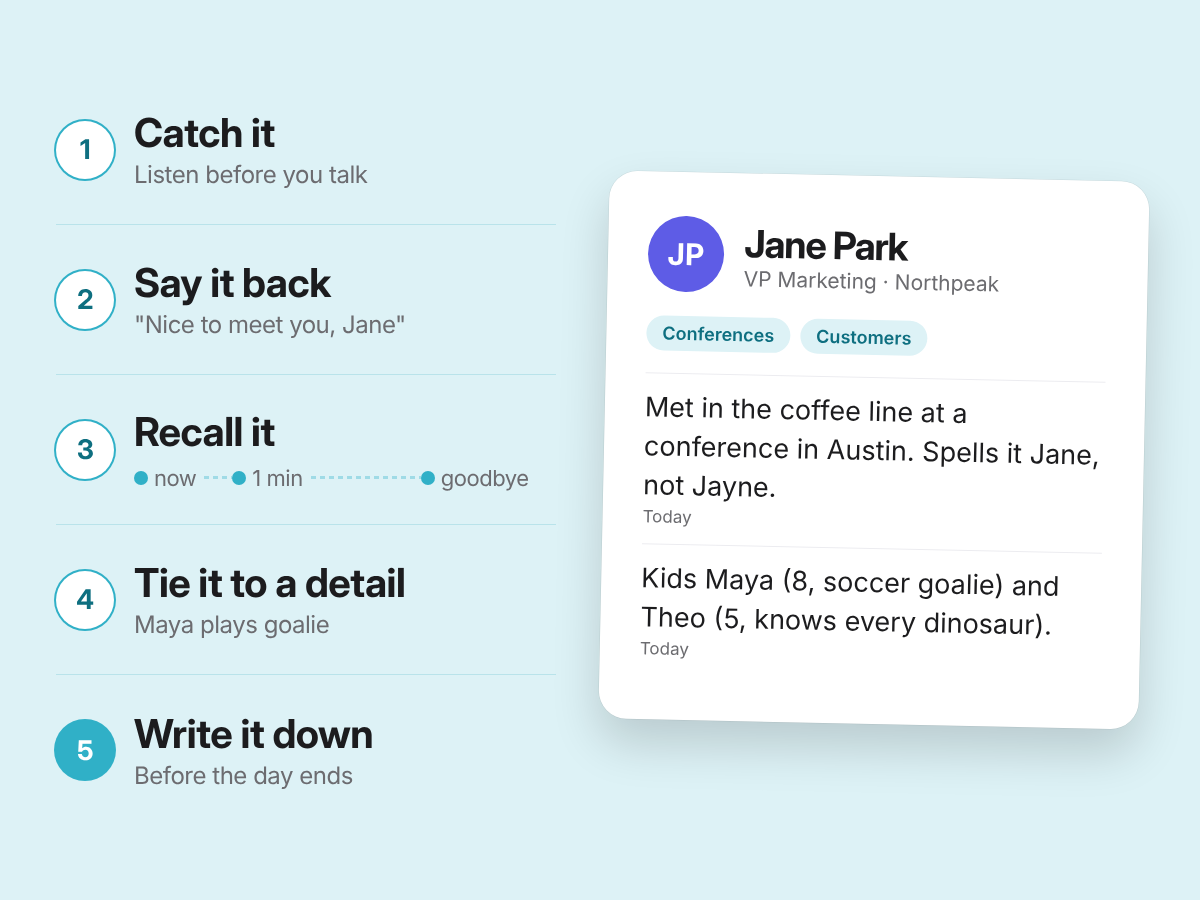
- Catch it. Before you say your own name, listen to theirs. If you didn't hear it clearly, ask right away: "Sorry, was that Jane or Jen?" Asking in the first ten seconds is easy. Asking an hour later is awkward.
- Say it back. "Nice to meet you, Jane." Saying it out loud checks that you heard it right, and it's warm. Use it once or twice more in the conversation. More than that starts to sound like a script.
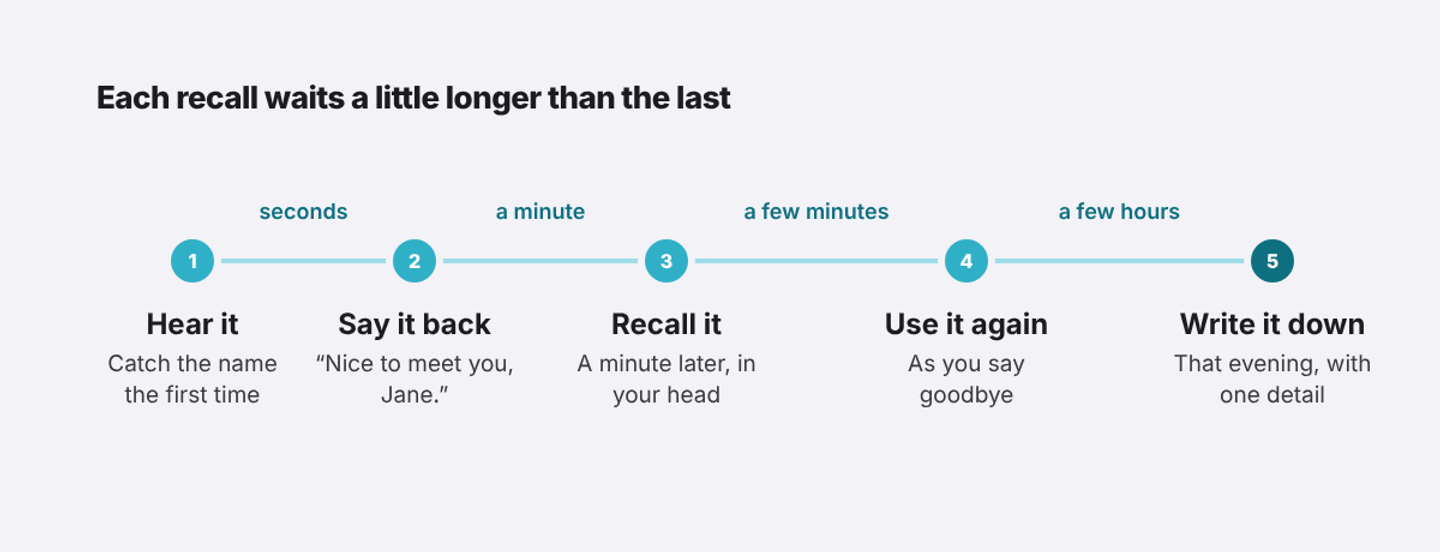
- Recall it with growing gaps. Quietly bring the name back to mind a few seconds later, again a minute later, and again as you say goodbye. In a 1978 study of name learning, Thomas Landauer and Robert Bjork found that practice recalls spaced at growing intervals beat recalls spaced evenly.
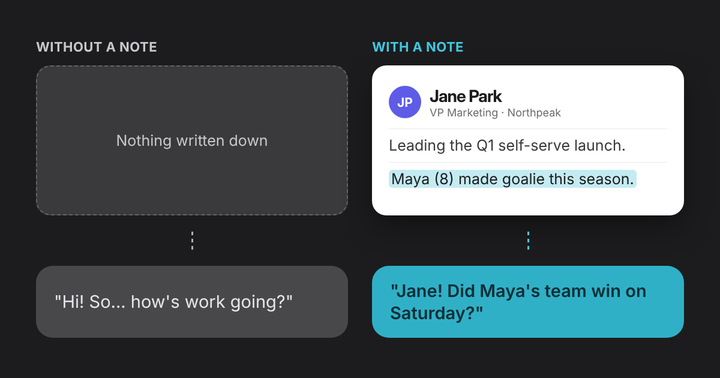
- Tie it to what they told you. A name sticks better when it hangs on something. Link it to the conversation: Jane, Northpeak, daughter Maya plays goalie, son Theo knows every dinosaur. That's the baker lesson in reverse. Give the name some ovens.
- Write it down that day. One line: their name spelled the way they spell it, where you met, and one detail only they told you.
- Look before you meet again. A glance at your note before the next coffee or call brings the name back right when you need it.
Picture tricks, like imagining Jane sitting in a park, work well for some people. Try one if you enjoy it. The steps above work even if you never do.
What should you do when you forget someone's name?
It happens to everyone. A few honest ways through:
- Ask early, and own it. "I'm sorry, I've lost your name." People rarely mind. It only gets harder the longer you wait.
- Bring in someone you know. "Have you met Alex?" When two people meet, they usually say their own names.
- Check what you already have. The meeting invite, their email signature or their LinkedIn profile usually has it.
- Don't fake it for months. If you've been getting by on "hey, you" since spring, ask. Then write it down so it's the last time.
What about the names of their kids, partner and pets?
These are the names people expect you to forget, which is why remembering them lands. Asking how Maya liked her first week of school shows Jane you listened to what matters most to her.
Dale Carnegie made the point about a person's own name in How to Win Friends and Influence People (1936): "Remember that a person's name is to that person the sweetest and most important sound in any language." We think the names of the people they love come in a close second.
Treat them like any other name. Say it back, write it down that day with ages for kids, and read an old note as a question, because Maya won't be six forever. On the sidelines, this is most of the job; Noted for parents shows how it works with a whole team of families.
What gets in the way?
- Calling yourself "bad with names." It turns a habit into an identity, and then you stop trying.
- Overusing the name. Once or twice in a conversation is plenty.
- Trusting your memory until next week. A name you heard once fades fast. Write it down the same day.
- Keeping notes where you never look. A list in a notes app is in another window when you need it. Keep it where you'll see it again.
Questions
Why do I forget names right after I hear them?#
Often the name never landed. When you're introduced, you're getting ready to say your own name, and a 1973 study found people remember least of what's said just before their own turn to speak. Names are also hard to hold because, on their own, they carry little meaning.
Is it rude to ask someone's name again?#
No. "Sorry, tell me your name once more?" is easy in the first minute and gets harder the longer you wait. Ask early, say it back when they answer, and write it down that day.
How do I remember the names of someone's kids or partner?#
Say the name back when they mention it, then write it down that day next to their name, with ages for kids. Glance at the note before you see them again. "How's Maya liking first grade?" shows you listened to what matters most to them.
Is it weird to keep notes on people?#
Not if you use them the way a friend would. Writing a detail down shows you were listening. Keep your notes kind and private, and use them to ask better questions.
- Michael Brenner The next-in-line effect (Journal of Verbal Learning and Verbal Behavior) (1973)
- K. H. McWeeny, A. W. Young, D. C. Hay and A. W. Ellis Putting names to faces (British Journal of Psychology) (1987)
- Thomas K. Landauer and Robert A. Bjork Optimum rehearsal patterns and name learning (Practical Aspects of Memory) (1978)
- Gillian Cohen Why is it difficult to put names to faces? (British Journal of Psychology) (1990)
- Dale Carnegie How to Win Friends and Influence People (1936)