What is Dunbar's number?
In 1993, the evolutionary psychologist Robin Dunbar estimated how many relationships the human brain can keep up. Working from how brain size tracks group size across primates, he arrived at about 150 for humans, close to the size of hunter-gatherer communities.
“So Dunbar's number is the limit on the number of people that you can have meaningful relationships with at any one time.”
"Meaningful" is a low bar on purpose. In the same interview, Dunbar describes the 150 as the people you wouldn't feel awkward walking up to if you ran into them at 3 a.m. in an airport bar.
What are the layers of 5, 15, 50 and 150?
The 150 isn't one flat list. It sits in circles, and each one is roughly three times the size of the one inside it.
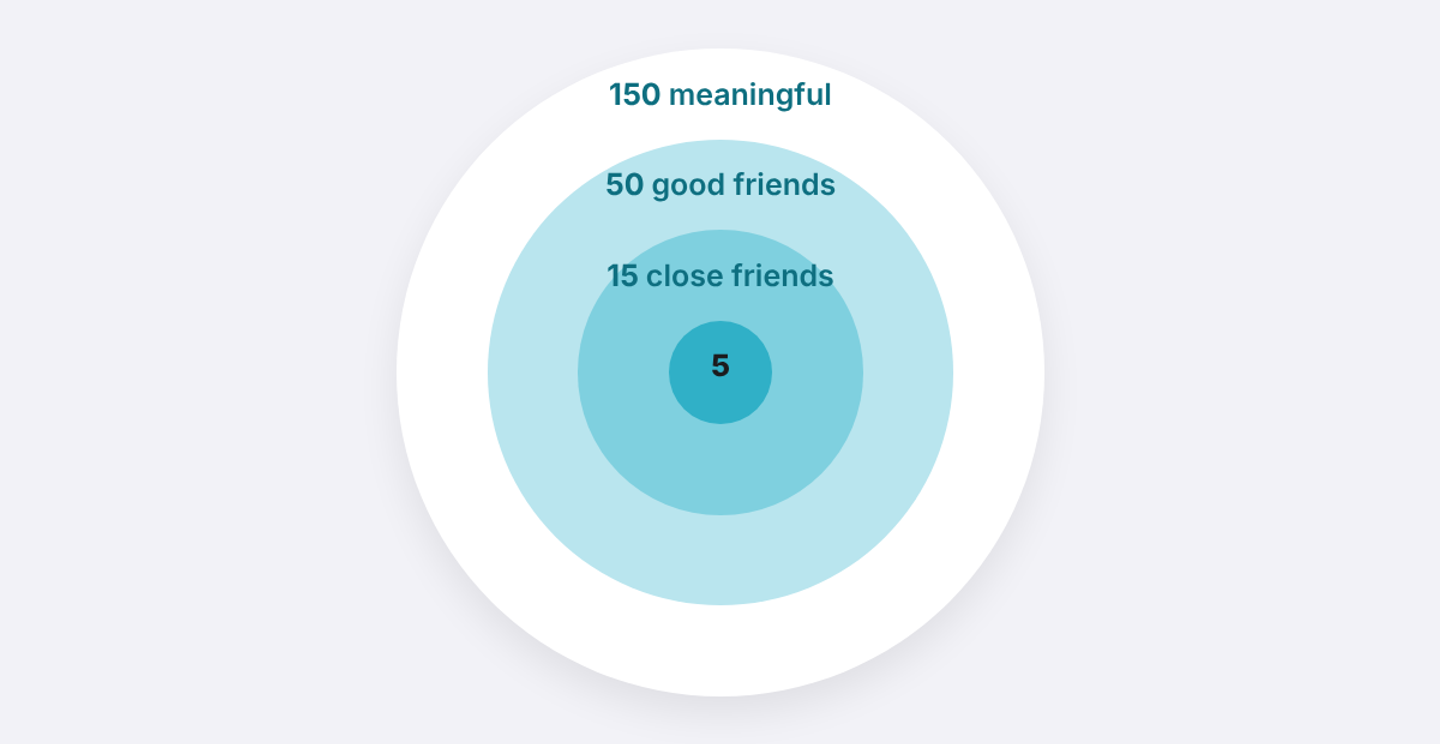
- About 5: the people you'd call in a crisis. Dunbar estimates they get about 40 percent of our social time.
- About 15: close friends you see often and would miss if they moved away.
- About 50: good friends. The people you'd invite to a big birthday.
- About 150: meaningful relationships. You know them as people, with some shared history.
The shape keeps turning up. In a 2003 study of Christmas card lists, the average network came to about 153 people. A 2016 analysis of billions of phone calls found the innermost and outermost layers close to the classic sizes, with more variation in between.
Is Dunbar's number real?
It's debated, and it's fair to say so. In 2021, researchers at Stockholm University re-ran the brain-size analysis with newer data and methods. Their estimates ranged from about 2 to 520 people, too wide to name one number. Their conclusion: you can't pull a precise human limit out of primate brains.
We treat 150 as a rough size, not a law. What holds up across the studies is the shape: a handful of people you're close to, and a much wider ring of people you know less well, where time and attention run thin.
What does it mean for your LinkedIn connections?
Your contact list can grow past 150 easily. Your attention can't. When Dunbar surveyed more than 3,300 people in 2016, Facebook users averaged 155 friends in one survey and 183 in the other. Only about 28% of those friends counted as genuine. The number people could turn to in a crisis was about 4, the same as offline.
So the outer ring is where people slip. You don't stop caring. You met at a conference, she told you about her daughter's first soccer season, and two years later you have her name and title but not the person.
Those outer-ring people matter more than they seem. Acquaintances and old contacts are often the ones with new information, which is why they come up so often in a job search and when you reconnect.
How do you stay close to more people than you can remember?
- Know your inner circle. You don't need a system for your closest 15. You need to protect time for them.
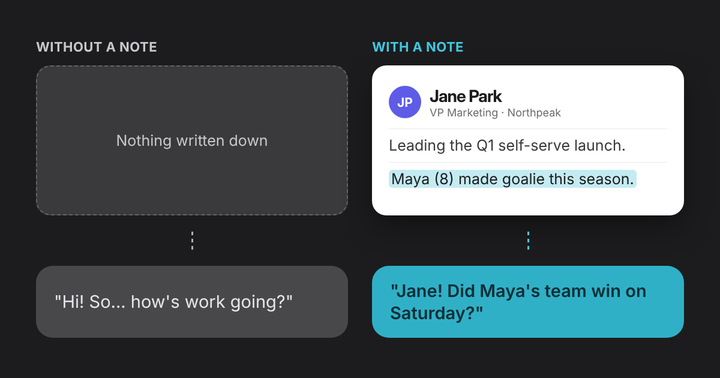
- Write one line for everyone else. The day you meet, note where you met and one thing only they told you. That's enough to start the next conversation.
- Keep it where you'll meet again. A note in a separate app is a note you won't open. Put it on their profile, in your inbox, on the meeting invite.
- Read old notes as questions. A detail from two years ago may have changed. "Is Theo in school now?" works better than assuming.
- Reach out with a reason. Something they mentioned, an article they'd like, a new job. One specific detail makes a message from the outer ring feel warm instead of random.
What else shapes who we stay close to?
Time, for one. A 2018 study estimated it takes roughly 50 hours together to go from acquaintance to casual friend (more on that for parents). Old contacts are worth reaching back to, and the research on reconnecting shows why. And what people tell you fades fast unless you write it down.
Questions
What is Dunbar's number?#
About 150. It's the number of meaningful relationships Oxford evolutionary psychologist Robin Dunbar estimates one person can keep up at a time, based on how brain size tracks social group size. The figure is debated, so treat it as a rough size, not a hard limit.
What are Dunbar's layers of 5, 15, 50 and 150?#
Inside the 150 are smaller circles of roughly 5, 15 and 50 people, each about three times the size of the one inside it. The closer the circle, the more of your time it gets. Studies of Christmas card lists, phone calls and Facebook friends have found a similar shape.
Is Dunbar's number accurate?#
It's debated. A 2021 reanalysis in Biology Letters found the brain-size method gives estimates anywhere from about 2 to 520 people, too wide to settle on one number. What holds up across studies is the shape: a few close people, and a wider ring of people you know less well.
Is it weird to keep notes on people?#
Not if you use them the way a friend would. Writing a detail down shows you were listening. Keep your notes kind and private, and use them to ask better questions.
- R. I. M. Dunbar Neocortex size as a constraint on group size in primates (Journal of Human Evolution) (1992)
- Russell A. Hill and Robin I. M. Dunbar Social network size in humans (Human Nature) (2003)
- W.-X. Zhou, D. Sornette, R. A. Hill and R. I. M. Dunbar Discrete hierarchical organization of social group sizes (Proceedings of the Royal Society B) (2005)
- R. I. M. Dunbar Do online social media cut through the constraints that limit the size of offline social networks? (Royal Society Open Science) (2016)
- Pádraig MacCarron, Kimmo Kaski and Robin Dunbar Calling Dunbar's numbers (Social Networks) (2016)
- Patrik Lindenfors, Andreas Wartel and Johan Lind 'Dunbar's number' deconstructed (Biology Letters) (2021)
- Robin Dunbar Robin Dunbar: Is there a limit to how many friends we can have? (NPR, TED Radio Hour) (2017)
- R. I. M. Dunbar Behavioral and Brain Sciences (1993)