What is an informational interview?
An informational interview is a short conversation with someone whose job, field or path you're curious about. You ask about their work; they share what they've learned. It usually takes 20 to 30 minutes, by video, by phone or over coffee.
It isn't a job interview, and that's the point. Think of it as career research, the way you'd ask around before picking a class. Nobody is evaluating you, and you're not asking for a job. You're trying to find out what the work is really like and how people got there.
A few good reasons to have one:
- See what a job looks like day to day before you commit to it.
- Learn how people actually got into a field. It's rarely a straight line.
- Hear which skills, classes and internships matter, from someone who'd know.
- Meet people who may think of you when something opens up later.
Will people really say yes?
More often than you'd guess. In three studies, Francis Flynn and Vanessa Lake had people predict how many others would agree to a direct request for help, then compared that with how many actually did. People underestimated how many would say yes, in some cases by as much as half. The researchers' explanation: when we ask, we focus on what saying yes costs the other person, and forget how uncomfortable it is for them to say no.
Talking with people outside your close circle can also pay off over time. In large experiments on LinkedIn, moderately weak ties (people you share a few mutual connections with) did the most for job mobility (Rajkumar and colleagues, Science, 2022). The study measured what happened, not why. Still, it's a good reason to talk with people you don't know well yet.
Who should you ask for an informational interview?
Start with people a few years ahead of you. They remember what it was like to be where you are, and their advice is current.
- Alumni from your school. On your school's LinkedIn page, the Alumni tab lets you filter graduates by where they work, what they do and where they live. A shared school is the easiest reason to reach out.
- Professors and their former students. Ask, "Do you know anyone working in [field] I could learn from?"
- Upperclassmen and recent grads who did the internship or took the job you're curious about.
- People you've met once: at a career fair, a club event or a guest talk.
- Family friends, and people a friend suggests.
- Your career center. Staff often know alumni who like talking with students.
For each person, find one specific reason you picked them: a role you're curious about, a project they worked on, a switch they made. That reason becomes the first line of your message.
How do you ask for an informational interview?
Keep the request short: who you are, why them, what you're asking for (20 minutes) and an easy way to say yes. Email works best for alumni and people you've never met. A LinkedIn message works once you're connected; our LinkedIn connection note examples cover the invitation itself. Each template below has a filled-in example.
Email to an alum you haven't met
Why you picked Priya: moved from agency work into product design
LinkedIn message, once you're connected
Why you picked Marcus: wrote about backing first-time founders
When a friend or professor suggested them
Why you picked Dana: Marcus says she started a company right out of school
If they haven't replied after a week
Send one follow-up, not three. If there's still no reply, let it go and ask someone else.
How do you prepare for an informational interview?
Fifteen minutes is enough:
- Read their LinkedIn profile and anything they've written or shared, so you don't spend the call on facts you could have looked up.
- Pick five or six questions from the list below, most important first.
- Write a two-sentence introduction: what you're studying, and what you're trying to figure out.
- Confirm the day before, with the time zone and the link or phone number.
- Have a way to jot short notes, and tell them you're writing things down so you don't forget their advice.
30 informational interview questions
You won't get through 30 questions in 20 minutes, and you shouldn't try. Pick five or six and leave room to follow up on what they say. If you only ask three, ask these: "How did you end up in this role?", "If you were starting out now, what would you do differently?" and "Is there anyone else you think I should talk to?"
Questions about their path
- How did you end up in this role?
- What did you study, and how much does it matter in your work now?
- What was your first job after college, and what did you take from it?
- Was there a moment when your path changed direction?
- What do you know now that you wish you'd known as a student?
- If you were starting out now, what would you do differently?
Questions about the work itself
- What does a typical week look like for you?
- What part of your job do you enjoy most?
- What's the hardest part?
- What surprised you about this work once you started?
- What kinds of problems are you working on right now?
- Who do you work with most closely?
Questions about the field
- How is your field changing?
- What skills matter most for people starting out?
- What do people often misunderstand about this work?
- Which teams or companies do you think do this especially well?
- How do people usually grow or move around in this field?
- What do you read or follow to keep up?
Questions about getting started
- What would make a new grad stand out to you?
- Which classes, projects or internships would you recommend?
- What should I be doing this year to prepare?
- Is there a skill I could start practicing now?
- What's a mistake you often see people make early on?
- How would you approach this search if you were in my position?
Questions to close with
- Is there anyone else you think I should talk to?
- Would it be all right to mention that you suggested I reach out?
- Is there anything I could help you with?
- What's the best way to stay in touch?
- Could I send you an update once I've acted on your advice?
- Is there anything you think I should have asked but didn't?
What questions should you avoid?
- "Can you get me a job?" You asked for a conversation, so keep it one. If they know of an opening, they'll often mention it.
- Anything five minutes online would answer, like what their company does.
- Their own salary. If pay matters to your decision, look up salary data first, then ask what a realistic starting range looks like in their field.
- Personal questions they haven't opened the door to.
How do you run the conversation?
Open with thanks and a one-line reminder of why you reached out. Then let them talk.
- Say the time out loud. "I know we have 20 minutes, so I'll keep an eye on the clock."
- Follow up on what they say. When they mention a project or a turning point, ask about it before moving to your next question. In studies of conversations between strangers, follow-up questions were the kind most tied to being liked (Huang and colleagues, 2017).
- Listen more than you talk. If you've been talking for a minute straight, ask a question.
- End on time, even if it's going well. "I want to respect your time" lets them offer to keep going.
- Ask who else to talk to. It's how one conversation turns into three.
What should you write down after an informational interview?
Write it within the hour, while it's fresh. A few lines is plenty:
- Their name, role and the date.
- The advice you're going to act on.
- Anyone they suggested you talk to.
- One thing they told you about themselves.
- Anything you promised to send or do.
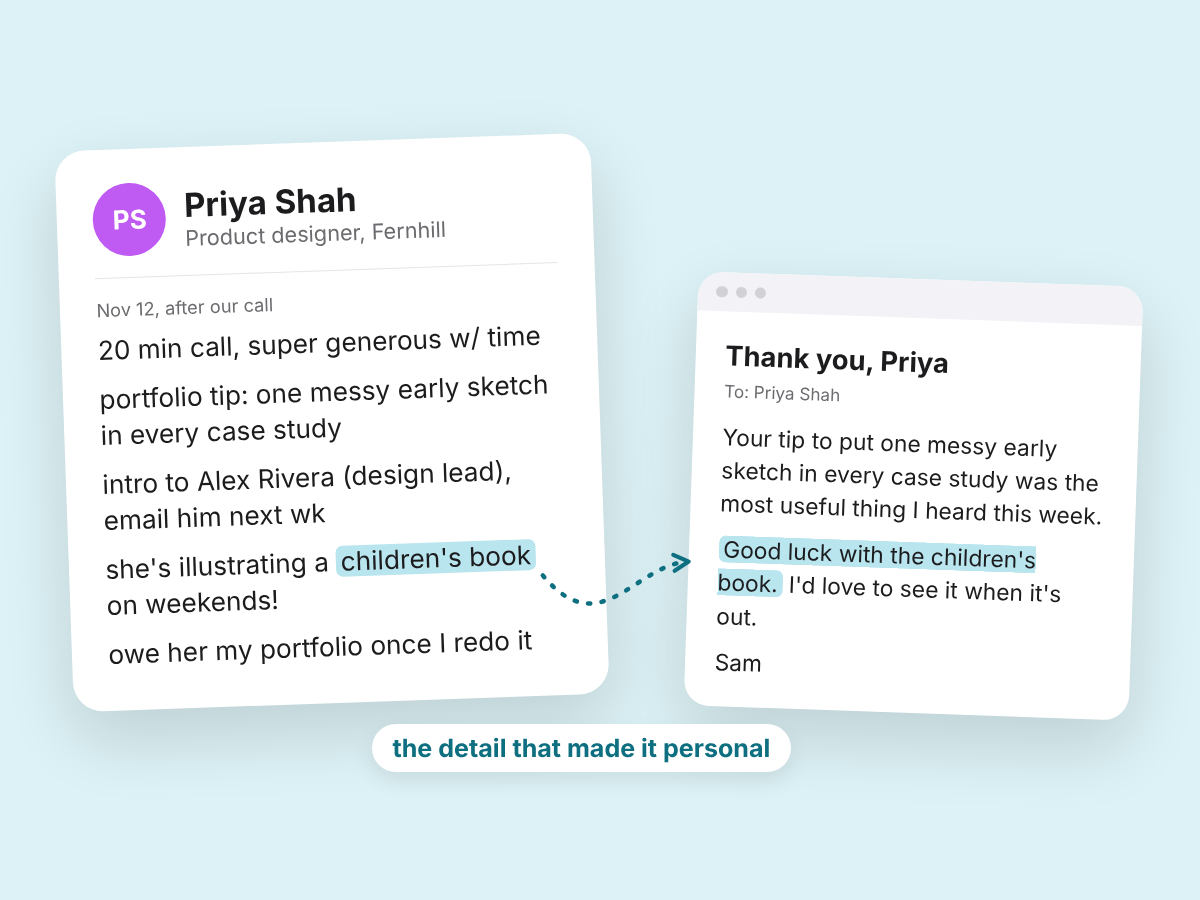
It doesn't need to be neat. Here's what Sam jotted after a call with Priya, a product designer at Fernhill: "20 min call, super generous w/ time. portfolio tip: put one messy early sketch in every case study. offered intro to Alex Rivera (design lead), email him next wk. she's illustrating a children's book on weekends! I owe her my portfolio once I redo it."
That one personal line, the children's book, is what makes the thank-you and the update months later sound like they came from someone who was listening.
How do you write a thank-you email after an informational interview?
Send it within a day. Thank them for one specific piece of advice, say what you'll do with it, and mention one thing they told you. Keep it short enough to read on a phone. For other moments, like after a career fair or a coffee chat, see our networking follow-up email templates.
From your note on Priya: sketching a children's book on weekends
If they suggested someone else to talk to, thank them for that too, and let them know once you've reached out.
How do you stay in touch afterward?
The best follow-up comes weeks or months later, once you've acted on their advice. "You suggested this, I did it, and here's what happened" gives them the satisfaction of having helped, and it's the most natural reason to write again.
From your note on Priya: sketching a children's book on weekends
Send it even if it feels small. Across 13 experiments, Peggy Liu and colleagues found that people underestimate how much others appreciate being reached out to, most of all when the message is a surprise (2023).
Common informational interview mistakes
- Asking for a job, or a referral, in the first message.
- Writing a long request. If it doesn't fit on a phone screen, cut it.
- Sending the same message to twenty people. One specific reason per person beats a mass message.
- Running over time.
- Forgetting what they told you by the time you write back.
- Never reporting back on how their advice worked out.
How do you keep track of everyone you talk to?
After five or six conversations, the names and advice start to blur. Keep a simple list with a row per person: name, where you met, what they told you, when you last talked and your next step. A spreadsheet is fine. Our guide to remembering personal details has more on what to write down.
If you're in the middle of a job search, Noted for job seekers covers what to write down after each conversation, so the details are there when you follow up.
Questions
What is an informational interview?#
An informational interview is a short conversation, usually 20 to 30 minutes, where you ask someone about their job, their field and how they got there. It's research, not a job interview: you ask the questions, they share what they know, and you don't ask them for a job.
How long should an informational interview be?#
Ask for 20 minutes and end on time, even if it's going well. If they want to keep talking, they'll say so. A video or phone call is fine; meeting for coffee is a bonus, not a requirement.
Can you ask for a job in an informational interview?#
Not directly. You agreed to a conversation about their work, so keep it that way. You can say what kind of role you're hoping for and ask who else you should talk to. If they know of an opening, they'll often bring it up themselves.
What if they don't reply to my informational interview request?#
Wait about a week, then send one short, friendly follow-up. If there's still no reply, let it go and ask someone else. Silence usually means busy, not no, and you can try again in a few months with news of your own.
I'm a student. Is Noted useful yet?#
Maybe most of all. Your classmates are your future network. Make a group for your class or section and write down the details while they're fresh. Interests, joint projects, and more. In five years, you'll be glad you did.
- Francis J. Flynn and Vanessa K. B. Lake "If you need help, just ask": Underestimating compliance with direct requests for help (Journal of Personality and Social Psychology) (2008)
- Karthik Rajkumar, Guillaume Saint-Jacques, Iavor Bojinov, Erik Brynjolfsson and Sinan Aral A causal test of the strength of weak ties (Science) (2022)
- Karen Huang, Michael Yeomans, Alison Wood Brooks, Julia Minson and Francesca Gino It doesn't hurt to ask: Question-asking increases liking (Journal of Personality and Social Psychology) (2017)
- Peggy J. Liu, SoYon Rim, Lauren Min and Kate E. Min The surprise of reaching out: Appreciated more than we think (Journal of Personality and Social Psychology) (2023)