Why does a follow-up email matter?
Most people you meet at an event never hear from you again. Not because you didn't like them. Because Monday came, and the moment passed.
The hesitation is mostly in our heads. In 13 preregistered experiments with nearly 6,000 people, researchers found that people consistently underestimate how much others appreciate being reached out to. The gap was biggest when the message came as a surprise (Liu, Rim, Min and Min, Journal of Personality and Social Psychology, 2023).
We misjudge the conversation itself, too. After talking with someone new, people tend to think they were liked less than they were. Psychologists call it the liking gap (Boothby and colleagues, Psychological Science, 2018).
So send it. The only real question is what to say.
Most of this works after a client or sales meeting too. The templates here are written for networking, but the approach is the same.
What should a networking follow-up email say?
- Use a subject line they'll recognize. Name the place or the topic: "Great meeting you at NRF" or "Thanks for coffee, Marcus". "Following up" on its own could be from anyone.
- Send it within a day or two. They still remember the conversation, and you still remember the details.
- Thank them for something specific. "Thanks for your time" is fine. "Thanks for the tips on hiring your first designer" is better.
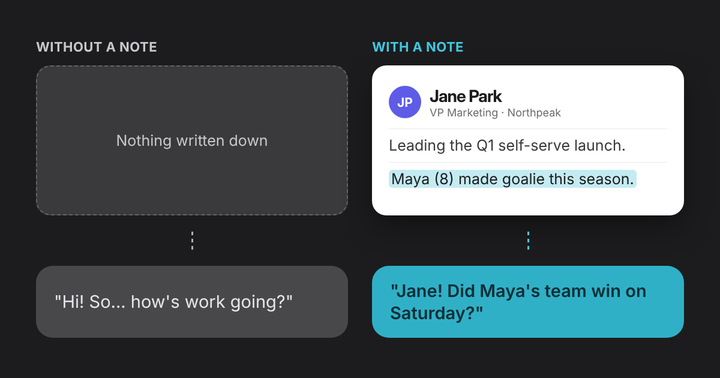
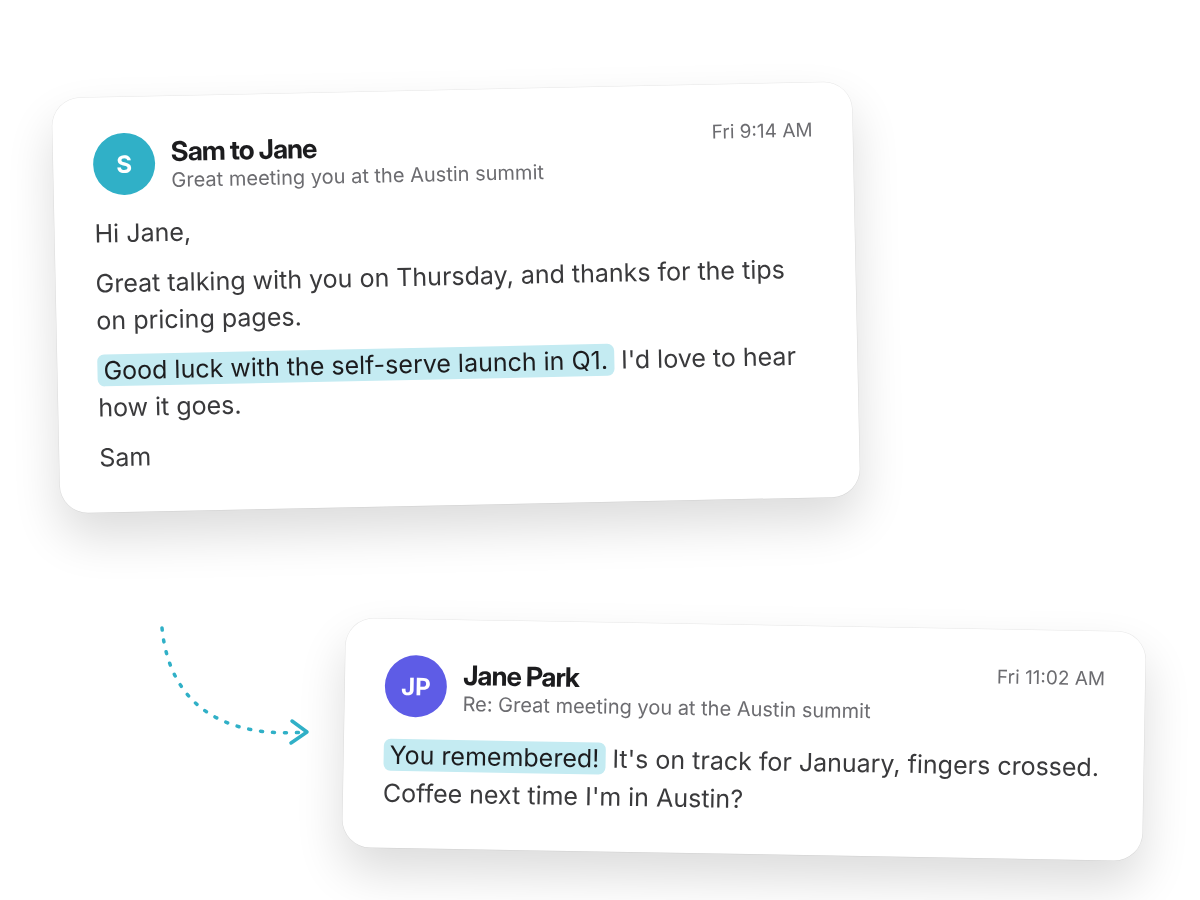
- Mention one thing they told you. The half marathon they're training for, the launch they're leading, their daughter's first week of school. This is the line that shows you were listening.
- Offer one easy next step, or none. A link you promised, a time for coffee, or simply "hope our paths cross again". One ask at most.
- Keep it short. 4 to 8 sentences. If it scrolls on a phone, cut it.

6 networking follow-up email templates
Copy the one that fits, fill in the brackets, then change the words until they sound like you. Switch to Example to see each one filled in. Every template has a slot for a detail. That slot matters more than anything else in the email.
1. After a conference or networking event
Use it when you met briefly, maybe connected on LinkedIn, and they met 100 other people that day. At a busy event, the detail is how they place you.
From your note on Jane: leading the self-serve launch in Q1
2. After a coffee chat or first meeting
Use it when you had a real conversation, half an hour or more. The "as promised" line matters too: a small promise, kept, says you meant it.
From your note on Marcus: training for the Sacramento marathon in December
3. After an informational interview
Use it when someone gave you their time and advice about their job, company or field. Telling them what you'll do with their advice shows it landed, and it sets up your next email, when you report back. If you're job hunting, Noted for job seekers covers what to write down after each one.
From your note on Priya: used to run the Austin design meetup
4. When they offered an introduction
Use it when they said "you should meet Dana" and you want to take them up on it without making work for them. With a note they can forward, the person introducing you only has to click Forward.
From your note on Marcus: training for the Sacramento marathon in December
5. The check-in months later
Use it when there's no event and no ask. You just want to keep a good relationship warm: a past client, a former colleague, someone you haven't talked to in a while. This is the email people most underrate. Remember the research above: the more of a surprise it is, the more it tends to be appreciated.
From your note on David: bought a house on Elm St; dog named Biscuit
6. When you're late to follow up
Use it when it's been weeks and you're embarrassed. Send it anyway. One line of sorry is enough. Then get to the point.
From your note on Sarah: wants to start a Saturday pickleball group
What subject line should you use?
One they'll recognize at a glance. Name where you met or what you talked about.
- "Great meeting you at [event]"
- "Thanks for coffee, [name]"
- "Thank you, [name]" (after an informational interview)
- "Following up on [topic]"
- "[Mutual contact] suggested we talk" (after an introduction)
Skip "Quick question", "Checking in" and "Touching base". They could be from anyone, about anything.
What mistakes should you avoid?
- Sending the same email to everyone. If a line could go to anyone you met, it says nothing to the person reading it.
- Leading with an ask. Thank them first. Ask small, or not at all.
- Writing a cover letter. Short emails get read. Long ones get saved for later, and later rarely comes.
- Getting the detail wrong. If you're not sure, ask it as a question: "Is Maya starting first grade this year?"
- Waiting for the perfect moment. A good email a week late beats a perfect one never.
How do you remember the detail a week later?
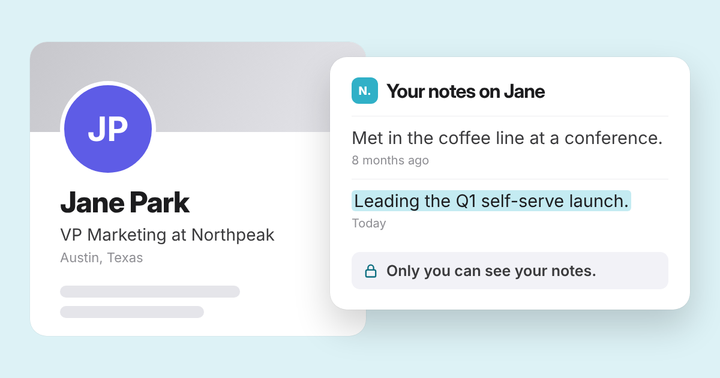
Every template here depends on one thing: having the detail when you sit down to write. After a day of meeting people, the details blur fast. So write one line the day you meet: their name, where you met, and one thing they told you. Our guide to remembering personal details has more on what to write down.
Write it once, in a few seconds, and it shows up on their profile, in Gmail when you reply, and in Google Calendar before you meet again.
Questions
How soon should you send a follow-up email after networking?#
Within a day or two, while they still remember the conversation and you still remember the details. If you're later than that, send it anyway. A short note a few weeks after beats no note at all, and people tend to appreciate hearing from you more than you'd guess.
What if they don't reply to my follow-up email?#
Give it about a week, then send one short nudge, ideally with something useful: the link you mentioned, or congratulations on news they shared. If there's still no reply, let it go. Busy inboxes swallow good emails, and silence is rarely a verdict on you.
Should I follow up by email or on LinkedIn?#
Use whichever they use. Email is better for anything longer than a couple of lines, or when you're sharing a link. A LinkedIn message works for a quick thank-you after you connect. If they told you how they like to be reached, write that down and use it.
Is it weird to message someone after years?#
Usually not. Most people are glad to hear from someone who remembers them. It helps to say why you're writing now: you saw their news, or something reminded you of them.
- Peggy J. Liu, SoYon Rim, Lauren Min and Kate E. Min The surprise of reaching out: Appreciated more than we think (Journal of Personality and Social Psychology) (2023)
- Erica J. Boothby, Gus Cooney, Gillian M. Sandstrom and Margaret S. Clark The liking gap in conversations: Do people like us more than we think? (Psychological Science) (2018)